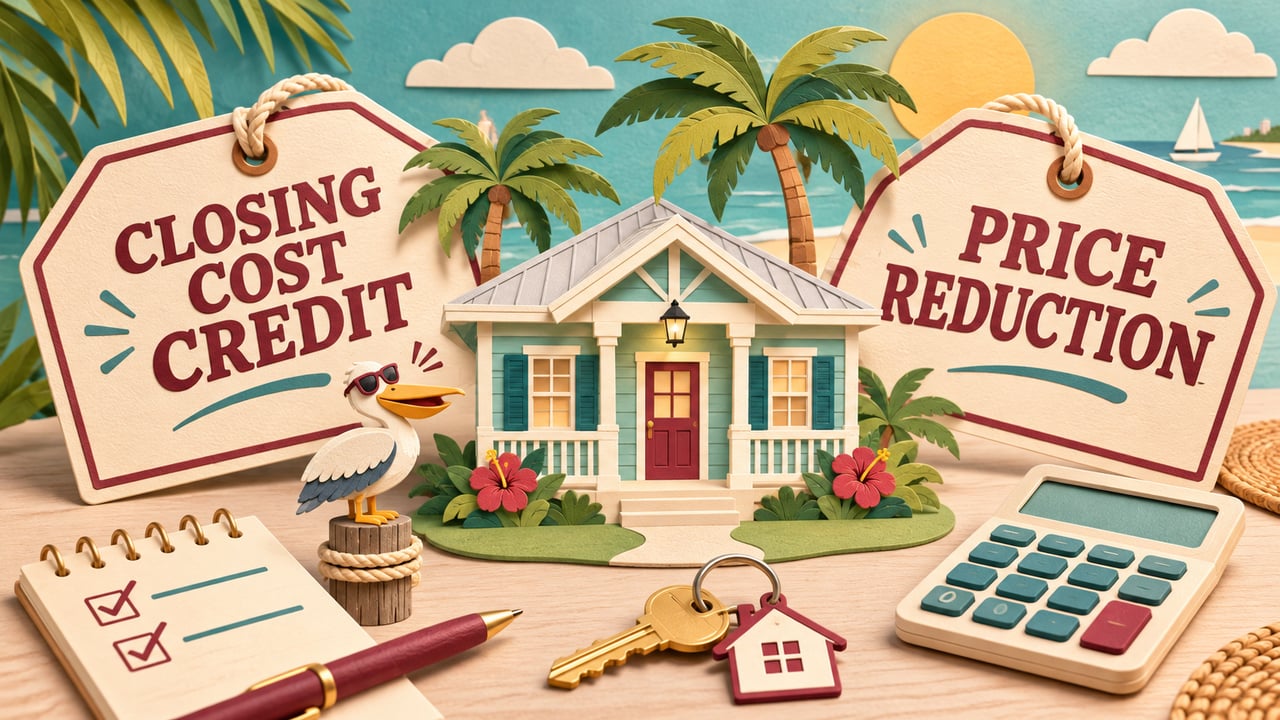
A buyer likes your Sarasota home but needs help with closing costs. Another buyer has enough cash but wants a lower purchase price. Should you offer the same solution to both?
Seller credits and price reductions can each help a transaction move forward, but they solve different problems. A credit can reduce eligible expenses at closing. A lower price reduces what the buyer pays for the property and, when financed, can reduce the loan balance. The right choice starts with identifying the obstacle.
What is a seller credit?
A seller credit is an agreed contribution toward the buyer’s eligible closing expenses. The Consumer Financial Protection Bureau explains that buyers can negotiate credits toward closing costs, which can include expenses such as appraisal charges, title insurance and certain prepaid items.
For a buyer who has saved the down payment but wants to preserve cash, this can be valuable. However, a credit does not automatically lower the mortgage payment. Its effect depends on what the lender allows it to cover.
What does a price reduction accomplish?
A lower purchase price can reduce the amount borrowed, the required down payment when calculated as a percentage of price, and the principal-and-interest payment. For a cash buyer, the purchase-price savings are immediate.
There is also a marketing difference. Reducing an asking price may put a listing within another buyer’s search range. A closing-cost incentive can help someone already considering the home, but it may not address an asking price that compares poorly with competing properties.
A $10,000 comparison on a $400,000 home
Consider a hypothetical purchase with five percent down, a thirty-year fixed mortgage and a 6.5 percent interest rate. This rate is an illustration, not a current quote. Assume the appraisal supports the price and the loan is approved.
- $400,000 purchase with a $10,000 seller credit: The down payment is $20,000 and the loan is $380,000. Monthly principal and interest are approximately $2,402. If fully permitted and used for eligible closing expenses, the credit offsets $10,000 of those expenses.
- $390,000 purchase without that credit: The down payment is $19,500 and the loan is $370,500. Monthly principal and interest are approximately $2,342.
The price reduction saves about $60 per month in principal and interest and reduces the down payment by $500. The credit offers substantially more immediate closing-cost relief, while leaving the larger loan balance in place. Neither is universally better.
These figures exclude taxes, insurance, mortgage insurance, association dues and other costs. The two options both produce $390,000 for the seller before other expenses, but the final seller net can differ because some transaction charges depend on price.
Check credit limits before negotiating
Under Fannie Mae’s contribution rules, a principal-residence or second-home loan with a loan-to-value ratio above ninety percent generally has a three percent financing-concession limit, based on the lower of price or appraised value. Credits also cannot exceed eligible closing costs or provide the required down payment or reserves. Other loan programs have different rules.
In the example, three percent of $400,000 is $12,000. A $10,000 credit is below that percentage ceiling, but the lender must still confirm sufficient eligible costs and account for other contributions. A larger credit on paper is not necessarily a larger usable benefit.
Should the credit pay for a rate buydown?
Discount points
With lender approval, a seller contribution may help pay discount points. The CFPB’s guide to points and lender credits explains that points exchange an upfront cost for a lower interest rate. The rate reduction varies by lender and loan; one point does not guarantee a one-percentage-point reduction.
Ask for a written comparison showing the cost, monthly savings and break-even period. If $4,000 in points saves $80 per month, simple break-even is fifty months. That illustration ignores the time value of money and other loan differences, but helps frame the decision. Consider how long you realistically expect to keep the mortgage.
Temporary buydowns
A temporary buydown subsidizes payments for an initial period. It does not permanently change the mortgage note’s terms. Under Fannie Mae’s temporary buydown guidance, borrowers must qualify using the note rate rather than the temporarily reduced payment. Evaluate affordability after the subsidy ends and do not assume refinancing will be available.
How to choose for a Sarasota-area home
For a Palmer Ranch villa, Venice condo or Lakewood Ranch home, begin with the buyer’s full budget. Include property-specific insurance quotes, estimated taxes and association expenses. An attractive principal-and-interest figure alone does not establish affordability.
For sellers: If showings are scarce and comparable homes offer better value, revisit pricing and presentation. If buyers like the home but struggle with cash needed at closing, a lender-approved credit may address that concern. Review our seller services when planning your strategy.
For buyers: Request side-by-side lender estimates using the same loan term and comparable assumptions. Compare cash to close, the full monthly payment, loan balance and expected ownership period. Our home-buying resources can help you prepare for that conversation.
Frequently asked questions
Can I receive unused seller credit as cash?
Do not assume unused credit becomes cash back. Ask your lender and closing agent how the permitted credit will be applied before finalizing the contract.
Can a seller offer both a lower price and a credit?
Yes, the parties can negotiate both, subject to the lender’s requirements and the agreed contract. Compare the combined package with the seller’s net proceeds and the buyer’s actual needs.
Build the offer around the real obstacle
A price reduction and a seller credit can have similar headline dollar amounts while producing very different results. Run the numbers before choosing either. If you are buying, selling or investing in Sarasota, Manatee or Charlotte County, contact Ram-Z Home Team at (941) 662-4550. Our team at Berkshire Hathaway HomeServices Florida Realty can help you evaluate the property and coordinate the negotiation with your lender.
Prepared November 4, 2026. Financing examples are illustrative; loan eligibility, pricing and allowable credits require lender confirmation.